

A Starting Point for Digital Commerce
Since I’ve completed most of my fintech-focused sensemaking (for now), it’s time to focus on digital commerce. To recap, I did deep dives on fintech and digital commerce + logistics for parts 1 and 2 of a podcast series called The Engine of African Venture: A Return to First Principles. The underlying hypothesis is that these sectors should drive the bulk of VC opportunities in Africa. The inspiration for this assumption has multiple sources, including:
First principles from The Trajectory Africa’s inaugural series. To synthesize what I learned from the first series of The Trajectory Africa, I created a compilation episode that distilled key learnings into six core principles. Three of them highlighted a path toward the next steps of my learning journey. We’ll get into the specific principles in more detail later in the piece, but let’s just say they highlight the opportunity in digitalizing African economies, investing in fintech as enabling infrastructure for these economies, and funding and supplying SMEs. In other words, fintech, digital commerce, and logistics.
A Unicorn founder said so. Olugbenga Agboola, Co-founder and CEO of Flutterwave, explained his belief that “there are three major pillars that can help Africa to leapfrog”— payments, commerce, and logistics—during a panel about the US’s role in supporting inclusive digital transformation in Africa, hosted by the Carnegie Africa Program on the margins of the U.S.-Africa Leaders Summit in 2022. Hearing that felt like validation for my direction of travel.
Aha moments from the pod. In a conversation that set the conceptual scaffolding for the fintech series, Abraham Augustine argued that payment rails have little utility without commercial activity passing through them. Eleven episodes later, Emeka Ajene pushed back to suggest that infrastructure incentivizes investment. Similarly, Samora Kariuki, in a conversation about the goals and components of a digitally-enabled financial system for Africa, linked the volume of trade to the size of an economy. So, whether you side with the chicken, the egg, or the omelet, it’s pretty clear that financial infrastructure (built on and through technology) and trade both matter.
Parsing the digital commerce opportunity did present a bit of a conundrum, though.
Principle #5 from the first podcast series seemed to provide a clear signal: “SMEs power tech startups by buying from them, and funding and supplying SMEs is a VC-scale opportunity.” But this didn’t jibe with the arc of reporting on the sector after its initial heralding. There were more and more reports about the business model challenges of companies like Alerzo and MarketForce, along with Sabi’s recent pivot. It seemed like theory meeting practice in an uncomfortable way. So, I dived in to do what I do (or what I try to do, anyway)—distill the core logic and fundamentals. As with fintech, the first step in my sensemaking process is to share what I heard from 12 brilliant founders and investors on what makes digital commerce opportunities tick. Here we go…
The Central Argument for What Markets Need: Replacement vs. Augmentation
I’ll confess that my conceptualization of digital commerce is dominated by B2B e-commerce, or the supplying, financing, etc. of informal retailers. There’s more to the story than this, clearly. But most of my conversations and insights are related to this particular flavor of digital commerce. Caveat aside, there is an operational tension that seems to characterize this segment: the decision to replace parts of “informal” supply chains or augment them.
The basic storyline is that during the post-ZIRP (zero interest-rate policy) era,
VC poured into African B2B e-commerce startups. Some of these companies focused on moving high volumes of commodity goods at razor-thin margins, achieving impressive gross merchandise value numbers that seemed to mask challenging unit economics. Questions emerged about the buoyancy of these business models, particularly those internalizing the difficult, complex work of building and restructuring supply chains—the so-called “asset heavy” (replacement) vs. “asset light” (augmentation) dichotomy. Typically, “asset-heavy” replacement is a strategy that connects supply from brands (also known as manufacturers and importers) to retailers, cutting out distributors and wholesalers as “middle men”. Augmentation is an “asset-light” strategy that delivers value to all supply chain actors, working with partners to handle the logistics (thereby eschewing asset ownership). In other words, within the realm of FMCG-focused business models, the elephant in the room has been asset intensity. Do you take an asset-light, augmentation-focused approach that adds value to everyone in the value chain using technology, or an asset-heavy, replacement-focused approach that disintermediates intermediaries? Or is it actually about asset efficiency, a strategy that preferences the flexible deployment of hard-working assets?
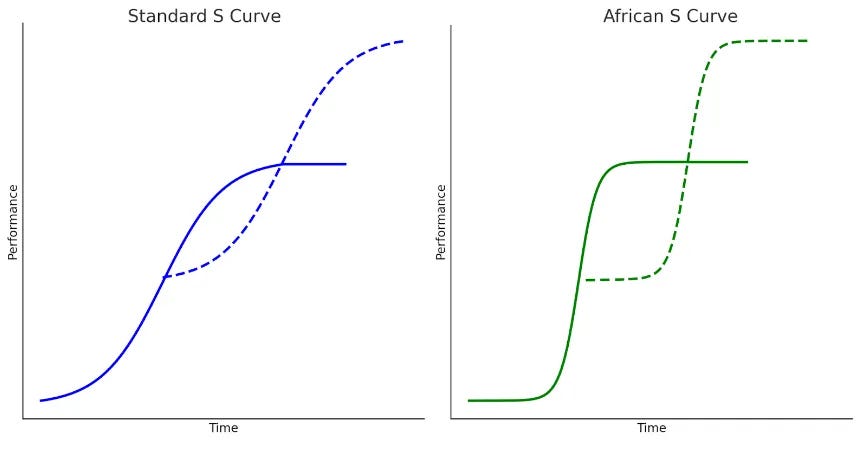
In the first episode of the digital commerce series, Stephen Deng, Co-founder and General Partner at DFS Lab explains how Africa’s S-Curves, his framework for understanding the trajectory of technology adoption on the continent, gives us a way to characterize the digital commerce opportunity. You should definitely read his piece in its entirety, but I’ll recap relevant bits to reflect the insights he shared.

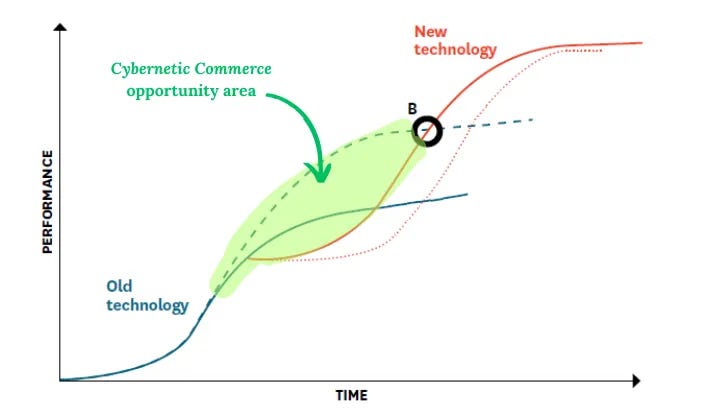
The basic idea is that technology adoption in Africa follows a slightly different pattern than it does in Western markets. If adoption is plotted with performance on the y-axis and time on the x-axis, you’ll observe that transitions take longer (longer tails), but once they happen, the acceleration is dramatic (steeper slopes). This challenges standard VC timelines and calls for more patience and precision in identifying inflection points that represent transitions from one adoption curve to another. This is important because there could be A LOT of value to capture between one curve (where technology currently is) and the next (where technology could be). That’s the opportunity. But there are different points of view on where the technology is, and where it could be.
Conceptually, this is one way to understand the augmentation vs. replacement dichotomy. To help clarify, Stephen names the inflection points that represent where two tech adoption curves intersect, as the market transitions from one technology to another. We’ll focus on two of these inflection points: Point B and Point C, which are defined as follows in Stephen’s piece:
Point B (cyborgs): Old tech can still improve, and the market is ready for new tech, causing a slower transition (e.g., hybrid cars to electric vehicles).
Point C (androids): Old tech can’t improve, but the market isn’t ready for new tech, so change is delayed until barriers are removed (e.g., traditional TVs to HDTVs).
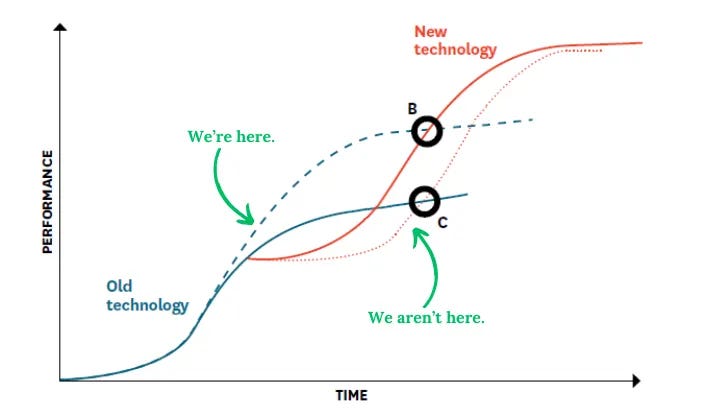
Point C represents a “replacement” strategy. The core idea is that replacement means “organizing” decentralized, informal markets, which often involves removing “middle men” who seem to detract from efficiency and transparency in B2B e-commerce supply chains. Doing so requires inserting technology-enabled assets to replace intermediary functions. For example, a startup may enter the market to reduce the cost of food by dropping the cost of moving FMCG food products through the supply chain. Presumably, the startup would do this by directly connecting informal retailers, who sell the FMCG goods to consumers, to brands and distributors, bypassing wholesalers that aggregate and distribute supply and taking a percentage of their margin for doing so. The same startup uses technology to make ordering and restocking these products cheaper and easier (less time spent procuring goods) for retailers while increasing price control for manufacturers, who can see when and where discounts apply in a way that wasn’t possible before. To be fair, these decisions are informed by pre-existing market structures and the demands of the business, i.e. securing high-quality, timely deliveries. If you can’t find third-party (3PL) partners to deliver this, you have to do it yourself. The point is that informal markets already work and aren’t interested in technology for technology’s sake. But Point C android companies try to remove barriers to tech adoption through user-friendly product design, market education, and in some cases, VC-funded subsidies. In other words, the market isn’t necessarily asking for new technology, but androids try to insert it because they believe it can improve efficiency, lower costs, etc. Note: The obvious crack in this argument’s armor is there’s no good reason why old tech can’t improve. It just seems like the market doesn’t really need or want it to.
Point B, however, represents an “augmentation” strategy. Instead of aiming to replace supply chain players such as wholesalers (which may not be possible in mature markets where they have more power), the goal is to create value for all the players and capture a portion of the surplus created. This tends to take the form of a platform where all the stakeholders can access information and services that boost their businesses. Manufacturers get access to a wider universe of retailers, visibility into and data on their products, and pricing control, such as the ability to run promotions. Wholesalers get an additional channel through which to sell product, along with the data that comes with it. Informal retailers get an easier, cheaper restocking process, critical financial and operational data, and higher customer retention because they can stock more goods, more reliably.
Thinking beyond B2B e-commerce, there’s also still room for technology to improve, as is illustrated by the emergence of conversational commerce—the way in which people and businesses use social media and WhatsApp as infrastructure for trade, and startups make that process easier, more efficient, and more lucrative through AI.
The Expected Outcomes of Augmentation and Replacement Businesses
Ultimately, the trick is knowing where the limits are for investing in technology and/or assets. With technology, there’s a ceiling to how much value you can squeeze—how much cheaper and faster you can make core processes. If you’re trying to circumvent physical infrastructure by building digital infrastructure, the reality is that you can’t fully replace physical infrastructure with technology indefinitely. That’s why companies like Maad, a retail platform connecting FMCG brands and retailers in Senegal, might have started with providing SaaS solutions to manufacturers, but were drawn into an asset-heavier approach.
But companies that choose to build infrastructure have to determine whether or not they can operate profitably while investing in the assets that drive replacement over time. They also have to determine if they can afford to completely build out that infrastructure. In many cases, the answer to both questions is no. Asset heavy models meet with difficulty because it’s hard to build end-to-end logistics infrastructure. New players are working with 3PL providers, which is more of an augmentation approach. Long story short, asset-heavy strategies are more expensive, (and arguably harder) to scale, and potentially less attractive for VCs to fund.
The core assumption though, is that point B, augmentation cyborgs are creating value not just by leveraging existing technology, but by finding the right mix of human and digital processes to help their customers grow their businesses. What does that look like? Stephen suggests that if you start to see economies of scale with physical infrastructure, then you’re heading in the right direction. A leading indicator of a cyborg’s scale potential is its ability to distribute devices, monetize each person/seller, balance liquidity, and reduce costs as volume has increased. To be honest, I’m not sure what this looks like in digital commerce. But perhaps it describes what’s happening with neobanking models like Moniepoint given its agent-heavy infrastructure.
Value Propositions for B2B E-Commerce Startups
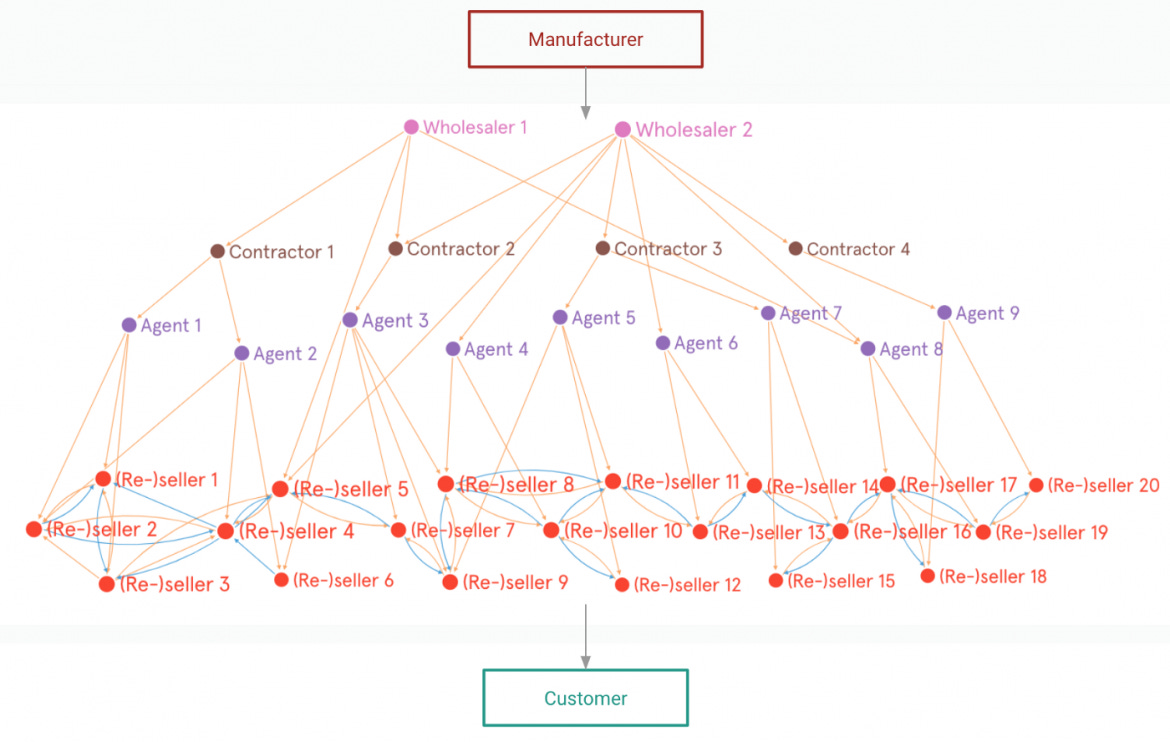
B2B e-commerce and informal retail supply chains can be quite complex. (Check out this piece from The Flip for a high-resolution point of view on what they look like and how they operate.) Digital commerce startups operate multi-sided platforms in supply chains with multiple stakeholders. The companies I spoke to, in fact, serve many customers, directly and indirectly. And they strive to create ecosystems of value, which makes sense when building a platform. For Maad, this means becoming the rails of the FMCG value chain with a goal to eventually digitize wholesalers, semi-wholesalers and customers, and integrate them into Maad’s platform, in order to increase value for all players in the chain.
However, these companies tend to directly serve at least one of two primary customers:
1) manufacturers or brands (often international, but also domestic); and 2) informal retailers. For example, Sidy Niang and Jessica Long, Co-Founders of Maad, described the value they deliver to both sets of customers. Maad focuses on brands as their primary customers because they hold most of the power and budget in the value chain. To brands, they offer a channel to sell to retailers, visibility into the value chain (who’s buying the product, how long it stays in stock, etc.), and value added services that enable them to promote new products through Maad’s digitized network. It’s hard for brands to offer discounts in informal value chains because wholesalers and retailers might take the discount for themselves and avoid passing it onto customers. This insight into how transparency translates into real value helped me understand how value chain visibility becomes monetizable as a value proposition—lack of visibility limits the ability to control price, e.g. knowing whether discounts or promotions are effective.
To retailers, Maad offers the widest range of products possible at competitive prices. But it would also like to boost the power of retailers in recognition of their collective potential. If all fifty thousand retailers in Senegal were part of a single entity, they would hold a lot of power. For example, they heavily influence what products sell through their merchandising decisions. As such, Maad wants to enable brands to direct more of their marketing budgets to retailers to reward them for their contributions.
Asset Intensity as a Strategic Choice
Perhaps obviously, the decision to invest in more or fewer assets reflects a founder’s point of view on the market being served. In a more mature one like Nigeria, there are probably enough third-party players who can serve as responsive, high quality distribution partners. Whereas in less developed markets like Tanzania, those partners aren’t readily available. I’d guess, however, that these decisions are also impacted by the time of entry—how the market was structured when the founder(s) started to tackle the problem. In my initial conversations with founders, I encountered three approaches to investing in assets to improve efficiency in B2B e-commerce supply chains. Two of these, asset-light and asset-heavy (or asset intensive), I described previously as part of the asset intensity dichotomy. The third, asset-efficient, represents an additional layer, which can also apply to the other two categories.
Asset-light
Interestingly, I didn’t pick up many learnings about running asset-light models despite feeling like many of the companies I encountered (including those in logistics), could be categorized this way. Frankly, it seemed like many companies had pivoted (or are pivoting) towards them. Fortunately, Lydia Idem, COO of LoftyInc Capital, gave voice to that inkling. From her point of view, B2B e-commerce businesses need assets to succeed—think trying to build Amazon with no postal service. But investors don’t necessarily want to fund the use of assets, at least not to a level sufficient to drive revenue growth. So, founders pitch and build asset-light models, all while trying to manage an unstable equilibrium between the needs of the market and those of investors.
I think that startups actually want to be more asset-heavy than they are, but they understand that VC doesn’t want to fund that. We all understand the challenges on the continent, but we want them to be solved with just digital and technology and no assets.
And then you [as a founder] get out into the market and the market is telling you otherwise. [Then] you understand why your competitors carry fleets or they hire drivers—all this stuff you thought you didn’t need to deal with and didn’t need to have. The market’s not responding, or you’re eating up too much cash because deliveries are getting lost, or you can’t find anyone who’s reliable enough to get the delivery on time. [You’ll] figure out how to do cash handling because [you] realize [your] customers aren’t digital. They only deal with cash.
What I’ve seen is that [companies] pivot to go asset-heavy because the market is requiring it. You can’t be a pure digital play quite yet. Then you’ll see companies try to pivot back because they just don’t have the money to adequately fund what they actually need to be successful. It’s this constant chicken and egg and you’re trying to flip between what gets funded versus what you need to be successful to drive the revenue you need to eventually get funded.The market is requiring you to become asset-heavy and you got funding for an asset-light model. I think we have to recalibrate as investors to understand how much heaviness actually needs to be in a business model for it to be successful.
One key insight did emerge, however, about the importance of incentive alignment in asset-light models. In a conversation with Dotun Olowoporoku, Managing Partner of Ventures Platform, on the Building the Future podcast, Deepankar Rustagi, CEO of OmniRetail, describes how successful third-party (3PL) relationships are incentivized by performance monitoring on the platform. Asset ownership is supposed to buy control. As such, if you have KPIs related to delivery speed and order quality and you depend on 3PL providers, you have to be aligned around the same goals. The way to secure this alignment is through incentives. As Lydia notes, successful asset-light models share the responsibility of using assets efficiently, and structure flexible, profitable contracts that enable productive partnerships.
Asset-heavy
Despite my best efforts, I wasn’t able to speak to a founder whose company was pursuing a truly asset-heavy, B2B e-commerce model until after the podcast series ended. Maybe this reflects the difficulty of running such models, as many have shut down or pivoted. But as I explained in the introduction to this piece, asset-heavy, replacement businesses purchase goods from brands and resell them to retailers, often disintermediating distributors and wholesalers. This enables more margin capture, but introduces significant difficulty, which I learned all about from Kikonde Mwatela, Co-founder and CEO of Exodus Mobility (also the former COO of Twiga), and Firas Ahmad, Group CEO and Co-Founder of Sarafu, a B2B e-commerce platform in Tanzania. In any case, two key observations about how to make the “heavy” part of these models work emerged, related to revenue assurance and customers’ willingness to pay.
Revenue assurance. As Kikonde explained, if you plan and execute the production side of your operations well, then the main challenge becomes whether or not you sell what you planned to sell. At Twiga, this meant selling an expected yield of bananas collected from farmers. But if, for example, you miss deliveries, your customers return products, or they don’t pay for what they ordered, you’re in trouble. Because beyond the cost of missed sales, the cost of figuring out what went wrong and why is high. When your margins are very thin, as they tend to be in FMCG value chains, these sorts of missteps can greatly increase your last mile logistics costs. And as Jessica and Sidy pointed out, these costs can sink a B2B
e-commerce business.Customers’ willingness to pay. According to Firas, part of making an asset-heavy model work is determining if customers are willing to pay for the level of service that the assets enable. In his words:
”You make it work by figuring out if people are willing to pay for that level of service. Because the market has produced third-party service providers that offer, say, level of service X, but you’re trying to sell a product that requires level of service Y. There’s a difference between X and Y. That difference might be a certain amount of cost. Are customers willing to pay that cost to get to that next level of service?
We have more than 7,000 shops that are ordering from us on a monthly basis. For them, the answer is yes. But we trimmed a couple thousand when we started raising prices to meet that value proposition. They said, no, we’re not willing to pay that price. So, in my mind, that’s how you make it work. You really need to go to the numbers and see what works and what doesn’t work and who’s willing to pay what for that level of value.”
Asset-efficient
It’s probably reasonable to assume that asset intensity and asset efficiency aren’t equivalent, but that efficiency can be achieved with different levels of assets. But in my conversation with Maad founders Jessica and Sidy, asset efficiency emerged as a distinct approach, and they described two key components of the strategy: experimenting to determine the optimal configuration of assets and optimizing operational gains.
Experimenting to discover the right configuration and intensity of assets. In the initial stages of a company when there are a lot of “unknown unknowns”—sandy roads during certain times of year, for example—it’s wise to be flexible and use data to determine what investments to make in logistics. As a result, experimenting and collecting data on your (daily) productive capacity is the only way to know what your infrastructure can handle. For example, Maad experimented with different types of trucks and warehouse pallet setups to figure out things like, what type of truck (a three-wheeler, for example) contributed the most revenue relative to its cost, and delivered the most deliveries with the highest level of fuel efficiency.
Optimizing operational gains. Another key principle is staying lean by optimizing output and minimizing costs. This includes a few key elements—revenue assurance (again), throughput and utilization, and peak management.
Revenue assurance. This underscores the point Kikonde made about the relationship between service quality and operational efficiency. Maad makes more money when it completes deliveries and keeps products in stock. Having high quality products contributes to the former because there are fewer returns, which reduces costs.
Throughput and utilization. Throughput and utilization work together to impact last-mile logistics and warehousing. For example, you can have a fully loaded truck, but if you make one delivery per day when you can do two, that’s only 50% utilization. To that point, Maad invests in route optimization because even a 5% increase in utilization can greatly improve the bottom line. With warehousing, the company realized that missing one day of deliveries each week (Sunday) was costly, so they switched to a 24/7 operation. With warehousing costs, the goal isn’t to reduce them upfront. The key is to increase throughput because a 2-3x increase only increases warehousing costs by 10-20%. If you optimize throughput, overall costs will decrease.
Peak management. Maad realized that it had to design its operational processes to match its capacity with changes in demand. For example, it had more deliveries to make earlier in the week, and before, during, and after holidays. To manage this, Maad has semi-automated limits on order volumes and set times at which to shut down ordering capacity.
Business Models
One message that came through clearly across multiple conversations with founders is how difficult it is to pull off a “pure play” B2B e-commerce model. Consistent with the idea of delivering value across the supply chain, cultivating multiple revenue streams seemed to be a common antidote. To sort this out, we’ll walk through why building a stand-alone, B2B e-commerce business is so challenging, along with the diversified revenue streams that companies are cultivating. But let’s reflect on business model archetypes as a starting point.
Circling back to Stephen, I asked him to weigh in on the three business archetypes that Anu Adedoyin Adasolum, CEO of Sabi, and Dotun Olowoporoku discussed on Building the Future. In short, they are: 1) buy (goods) low, and sell (them) high; 2) make processes more efficient; and 3) put more money in the pockets of whomever you’re serving. From Stephen’s point of view, the third option is the only compelling one, but it’s an opportunity that results from proficiency with the first two. To break this down further, in option 1, margin will be gradually competed away if you’re operating in a free market. In option 2, more efficient processes will eventually become the standard. But presumably, the better you are at trading and improving processes, the more proficient you become at creating real value. For example, in the context of B2B e-commerce, retailers can make more money when digital commerce startups sell goods to them more cheaply (which they do through buying low and selling high) and more accessibly (which they do by using technology to improve ordering, stocking, and inventory management processes). At some point, you’ll reach a cost floor and squeeze all possible efficiencies out of a supply chain. But leveraging options 1 and 2 can create opportunities to make money, for some period of time.
The question, I suppose, is how. According to Stephen, if you’re good at helping people make money, you’re probably also good at a few other essential tasks like delivering a sticky product, getting to know your customers extremely well, and offering the tools they need to make more money over time, such as providing credit and helping them grow their businesses—from one storefront to seven, for example.
With this basic framework in mind, it’s a bit easier to understand why a “pure play” B2B e-commerce business might struggle. Early on, some of these companies tried to reduce the costs and increase the efficiency of supplying and selling basic commodities. Because these are common staples sold in bulk, the GMW growth numbers were massive. But commodities are essentially zero margin products. And in countries like Kenya, commodities are everywhere because everybody needs them, and the informal market has found a way to efficiently (or at least efficiently enough) sell them at a reasonably low price. So, if you have to build costly technology, logistics, back office and people infrastructure to “improve” the efficiency of distributing these products, it’s clear why achieving profitability would be challenging. You’re essentially earning the same slim margins that wholesalers do, while having to cover the costs of investments they don’t typically have to make. Firas breaks it down like this:
“When all this venture capital poured into the B2B e-commerce space in East Africa, about 2021, 2022—I think it was a total of half a billion dollars, maybe even more than that. That was focused primarily on some aspect of delivering basic consumer goods from businesses to businesses. And what we saw after that funding round were these big gross merchandise value numbers where people were talking about selling 50 million, 100 million in a month; $250 million worth of product was sold. Most of those sales were commodities. And when I talk about commodities, particularly in the FMCG space, I’m talking about three products: flour, sugar, and oil.
These three products are the core staple products that are consumed by everyone everywhere in every country in East Africa almost daily. The problem with focusing B2B commerce on commodity products is there’s practically no margin. These are commodities that are actually well distributed across the country because everybody needs them. The informal market has found a way to sell these commodity products at a relatively inexpensive price without needing a lot of inefficiency. Everybody pretty much has flour when they need flour. Everybody has oil and sugar. So, these platforms came in and they took over this commodity distribution process, but almost at cost or at no margin. As a result, you built these large numbers around gross merchandise value that actually were quite empty when it comes to margin value or net revenue.
The assumption here is that if you use the Silicon Valley playbook, you acquire a bunch of customers at a deficit and then eventually you will start to monetize them over time. And that doesn’t work in Africa, particularly in the B2B space, because these are commodity products and they’re available everywhere. So, building a business on a zero-margin value distribution platform is not likely to succeed.”
Further support for this point of view is provided by the diversified revenue streams built out by Maad, Sarafu, and Chari, described briefly below:
Maad Co-founders Sidy and Jessica acknowledge that it’s difficult to build a profitable B2B e-commerce business supplying commodity staples to retailers because they’re low to zero margin products. They rightfully note that even big, successful companies like Amazon or Alibaba don’t have pure play e-commerce businesses, and they operate in big, mature (or maturing) markets. This probably explains why they’ve taken inspiration from three of Amazon’s main service lines: Amazon advertising, Amazon Pay, and AWS. Mirroring this approach, Maad has three revenue streams: 1) buy low, sell high, which is where they make the most net revenue; (I described this earlier—buy products from manufacturers at a discount (or import goods) and sell them to retailers at a higher margin. 2) capitalize on rebates earned or negotiated for selling a certain amount of product; and 3) earn advertising revenue, which Maad generates when brands pay a fee to access its digital advertising network, physical advertising, and merchandising to promote products.
It’s worth noting that for the trading part of Maad’s business model to work, retailers have to order products other than commodities. To incentivize this, Maad limits how many staples can be ordered on their platform, directs retailers to other products, and organizes its loyalty program to support the purchase of non-commodity products.Firas describes his strategy for building Sarafu as taking an ecosystem approach, which means offering digital commerce, payments, and logistics through Sarafu’s platform. Not surprisingly, the business model has three parts:
facilitating e-commerce, which is selling mostly branded goods to retailers who will pay a premium, i.e. 8-9% margin, for reliable supply;
processing a high volume of small transactions ($4-$20 payments on average), earning 50% of a 3% processing fee, plus margin on a percentage of the payment channel required to process that transaction; (Note: The payment processing is managed by AzamPay, Sarafu’s sister company.)
managing logistics for other companies, i.e., executing a specific number of deliveries for a fixed quantity of products to be delivered within a certain timeframe.
Beyond the above, Sarafu’s trading business has some design features that are worth noting, including that it’s part of a family of businesses that isn’t VC-funded. First, Sarafu is serving customers who are at a location disadvantage. Some retailers operate beyond the regular routes of brands and distributors, but still want predictable supply. In other words, if a retailer is located in a dense, high-traffic area that is well-served by wholesalers or manufacturers with their own outlets, it’s probably not an ideal customer for Sarafu. But if the retailer is in an outlying area where there is lower customer density, it’s a good fit because it won’t be reached by the existing distribution infrastructure. This type of retailer is willing to pay more for reliable service. For them, Sarafu unlocks trust-worthy and convenient access to inventory. These shops are willing to pay a premium because they want to receive products on time, return them, experience good customer service, and have a one-stop shopping experience to avoid going to 5-10 different suppliers every day. Secondly, Sarafu sells mostly branded products and premium-priced commodities. This might lead to lower GMV numbers, but it’s also how they achieve 8- 9% margins.
During our conversation, Ismael Belkhayat, Founder and CEO of Chari, stated plainly that B2B e-commerce business models simply don’t work well from a business model perspective. As Ismael recalls:
“I think everyone remembers the old days of 2020 when the interest rates were low or almost negative, and the money was free, and investors were looking for those startups that were growing very fast. And the investors were telling us, ‘Hey, keep growing. What’s important today is your top line.’
Fast forward to 2022, the war between Ukraine and Russia started. Then, inflation went up and all the central banks of the world brought up the interest rates and of course, no more free money. And all those investors who used to ask founders like me to keep growing and focus on the top line all of the sudden started asking about the path to profitability, unit economics, and the bottom line.
And you know, we woke up one day and started realizing that many of us had great growing companies, but with no real business model. Like everyone, we started looking into our unit economics and we realized that B2B e-commerce is a very tough business in the sense that the margins are slim. At the end of the day, you are a distributor of fast moving consumer goods. So, you are getting the same margins as wholesalers. And those margins have to cover your logistics, your technology, your back office costs and so on…”
For Chari, e-commerce is the “trojan horse” that allows it to acquire merchants, through whom they deliver and monetize fintech services. As such, Chari’s revenues come from transaction fees from: 1) money movement, i.e. acquisition fees when money comes in, and interchange fees when money goes out; 2) transaction fees when merchants use Chari-issued cards; 3) interest on the money in merchants’ custodian accounts, and 4) a percentage of value-added services sold by merchants, e.g. merchants help Chari acquire customers for Orange and train them on how to use the services.
Source: Bettmann / Getty Of course, Chari aims to lower the costs of running a B2B e-commerce company so they don’t drag down the profitable parts of the business. For example, although building and managing a distribution network is a significant cost for a money transfer service, having an in-built distribution network composed of merchants reduces it. Also, more importantly, the trust Chari has built as a supplier of goods and financial services to its merchants makes them willing to serve as distributors.
Now, remember Lydia from LoftyInc? Her point of view runs counter to the assumption that attaching fintech to a digital commerce business will boost margins, although the ability to process payments is clearly a core part of the business. The logic is that a digital commerce business that partners to access payment processing will share margin with a bank or fintech. And if that company acquires a license to avoid revenue sharing, it’s a sizable investment that might not be the best use of capital for a company that isn’t running a full-on financial services business. As Lydia explains:
I know a ton of these startups then get into the business of acquiring their own licenses because then they don’t have to partner with the bank, right? They’re capturing more of that margin. That’s an expensive proposition. I’ve seen plenty of decks that are pitching me because they want investment dollars to purchase the license. Honestly, it’s not really what the financing should be for.
I almost think the fintech play, it’s like putting AI on your deck. It’s a way to get the dollars because fintech gets all the money. So, if I have a fintech play, then I’ll get the money. But it’s not your space. You don’t know the other side of being a successful fintech company or a payments company. I don’t think [having a license] is a central piece of having a successful commerce business model.
A notable caveat when executing an embedded finances strategy is timing. Once a business reaches a certain level of scale and growth, then tacking on value-added services makes more sense.
Margins
Perhaps not surprisingly, the pathway to increasing margins aligns with the strategy a company takes—augmentation (providing value to all stakeholders) or replacement—taking roles from intermediaries, along with the associated margins. From Maad’s perspective, there’s a case to make for augmentation. If you’re able to deliver value to everyone, you can preserve your margin. Additionally, if you help value chain players grow their revenue streams, they have more money to spend on your platform. Of course, you’re still an intermediary that connects brands and retailers, even if you replace traditional “middle men”. This means that both brands and retailers can exert margin pressure on you—brands can threaten to increase the prices of the goods you resell, and retailers can demand low prices to incentivize their purchases. Offering a unique value proposition that’s only accessible through your platform, such as deep access to retailers and quality merchandising for brands, is one way to combat this.
Ecosystem approach notwithstanding, Maad still focuses on brands as its primary customers because there’s more margin available. If you serve a manufacturer, there’s more margin to split because goods pass from the manufacturer to a distributor/wholesaler to a retailer. If you choose to work with wholesalers and distribute to retailers, the only available margin is between wholesalers and retailers.
Now, if you take a largely replacement approach, there are five basic ways to boost margin capture. All but the first one should apply to augmentation as well. Firstly, you can disintermediate value chain players like wholesalers. Secondly, you can capture non-distribution revenue streams such as brands’ marketing budgets. Thirdly, you can sell digital services to retailers, like Maad does, if you help them capture more value from goods merchandizing, leaving them with more margin to spend. Fourthly, you can build value-added products, such as loans, advertising, and inventory management, etc. Finally, you can make the compounding of small gains work in your favor. For example, you can negotiate to increase the rebates from annual contracts with your top suppliers. A 0.5-1 % increase in margin adds up at scale.
Not everyone believes that “snatching” additional margin across the value chain is the way to support B2B e-commerce models that don’t quite work as standalone businesses. In fact, Lydia prefers disciplined focus:
I think you can only move into these other services after you’ve achieved some level of either profitability, a critical mass of users, or a ridiculously low churn rate that [enables you to] experiment on your current client base. Adding more services early in the life of a business is due to a need to grow—the initial business model isn’t growing fast enough, so you might be feeling pressure from your runway. You’re probably also feeling pressure from your investors to grow faster. And you’re now looking at…how I can add this service or that service to create more streams of revenue so I can get to that growth.
I think any business we’ve seen gain massive success has been laser-focused on a singular business model and revenue model. And they’ve grown that to the point where they’re now able to sufficiently fund other services or other experiments and see what sticks and then grow that.
Cost Management
Remember what we learned about revenue assurance? It’s a key component of managing costs. Unsurprisingly, reducing the cost of last mile distribution is a central theme of overall cost management. As the Maad founders explained, the costs of last mile distribution, or delivering something from a warehouse to a point of sale, are often higher than warehousing costs. Of the 6-6.5%+ margin that Maad earns, most of it is eaten up by last mile costs, followed by warehouse and fuel costs. So, if deliveries aren’t tracked carefully, the cost of managing returns, e.g. missed and damaged product deliveries, will increase. That’s why it’s so important to build a sustainable, scalable, core distribution business that produces unit cost profitable deliveries. Failure to achieve operational excellence—on-time deliveries that meet customer expectations—is expensive. In fact, meeting delivery KPIs is what enables Maad to cover its logistics distribution costs. Recalling what Sarafu founder Firas noted, the informal market doesn’t have software like ERPs, or the costs associated with them. This means that a technology-enabled provider has to scale in order to cover the costs that smaller, nimbler competitors don’t have.
Sarafu reduces its logistics costs, i.e. the price to deliver a kilogram of product in Tanzania, by optimizing routes, driver behavior, and vehicle maintenance costs. Processes are automated, and warehouses are positioned to minimize distances travelled. Interestingly, experiments with electric vehicles yielded a reduction in delivery costs of 50-60 % because of lower maintenance and fuel costs. Finally, Sarafu’s sister company, AzamPay, built bespoke payment infrastructure to combat high failure rates (10-15%) of online payments. Solving this problem in-house reduced its operating costs, improved the efficiency of payment processing, and became a service that Sarafu sells to other companies, e.g., subscription service providers like bus ticketing agents.)
Scaling
Jessica Long from Maad shared a pretty core assumption—that distribution is a scale business. Notably, Maad and Chari share complementary points of view on how to scale this type of business. Maad’s approach is to focus on deep, concentrated penetration before scaling outside of the country. This means achieving 50% penetration in a single Dakar neighborhood, before growing to 50% penetration across Dakar, etc. When it can’t grow anymore, then it will replicate what works in a larger market. Essentially, Maad believes it can build a big, ambitious business by capturing 20-40% of the Senegalese market first. And it’s doing this as a distributor that delivers value-added services such as advertising that can be paid for with marketing budgets. Ismael from Chari found that he couldn’t replicate the B2B e-commerce business beyond Morocco, so he shut down e-commerce operations everywhere else and focused on fintech outside of the country.
Managing Expectations: When Form Must Meet Function
Conveniently, we’ll end this tour of digital commerce insights where it began. I started this learning journey with fintech and digital commerce because I assumed they had characteristics that lent themselves well to VC, at least as it’s currently practiced. But the infrastructure gaps that are common to most African markets seem to require assets to a degree that this iteration of the model isn’t well-suited to accommodate. Part of the solution might be to explore an earlier version of VC that funded asset-intensive ventures and/or geographies with market characteristics that are more similar to those in Africa (China, India, or Brazil, for example), to find an appropriate comparable.
Keeping with the full circle energy, let’s revisit Africa’s S-Curves in the context of digital commerce. Stephen told us that their longer tails and steeper slopes mean that technology adoption transitions take longer, but have huge impact potential once they do. The job of investors, then, is to recognize when markets are about to shift and invest during the (early) growth part of the curve. Presumably, one of the main reasons technology adoption is hampered (until it isn’t) is the previously mentioned infrastructure gaps. But those gaps also help define inflection points, which indicate when it’s time to invest.
The inflection point that Stephen’s betting on is Point B, when old technology can still improve but markets are ready for new technology. Why? Because as Lydia points out, these oft-mentioned infrastructure challenges can be navigated with new technology (or better old technology). Think back to the Amazon analogy. There’s a reason why startups in Lydia’s portfolio are creating addressing systems—technology to improve the delivery of physical goods with physical assets. Clearly, this tech must be designed to accommodate market nuances like these in order to help, rather than hinder, adoption. But if Stephen and Lydia are both right (including everything Lydia said about digital commerce needing assets that VC won’t pay for), it’s going to take time to get to the other side of that lucrative growth period.
Perhaps the first step on that path is to cultivate a deep respect for what needs to function and how. As Lydia acknowledges, digital commerce startups probably have to engage in some disruption and replacement to assert a level of control over fragmented supply chains that ensures consistent, high quality, customer service. That suggests that some amount of asset ownership is a key to success. The second step is to think about the extent to which form meets function. This is where things get uncomfortable on the investors’ side of the table, in terms of fund durations and the type of capital deployed.
On the first point, as I mentioned above, there are signs pointing to the need for patient investors deploying patient capital. Practically speaking, this means funds that last longer. Here’s how Lydia explains it:
I think the implications for fund returns really has meant that fund managers and LPs have to understand that because of the physical aspect—it’s not a pure digital play—there just has to be more patience. And so, you’re seeing many of us take on longer duration funds.
We (at LoftyInc) had the luxury of short duration funds, which made it more compelling to LPs who are used to the typical 10-year fund life cycles. Some of the early VC funds were five years. And we could enjoy that five year [duration] because rapid disruption was happening in areas like fintech.
We’re all now looking at sectors like e-commerce and we realize (and I would include agriculture in this) they require tenure. And we have some fund managers talking about 12-15 year funds. But what people aren’t realizing is that these 12-15 year life cycle funds are happening in the US now in VC. They’re not doing 10-year fund life cycles as much as I think we think they are. They have moved beyond that as well, and the innovation ecosystem in the US is very, very mature.Adoption and valuation growth are also going to take longer. So, I think that’s where we need to start. Before we start thinking of fund returns, we need to make sure we’re erecting the appropriate investment vehicle(s) that will allow companies to mature into the valuations that give us the fund returns that we’re all targeting.
Another way this form vs. function tension shows up is the need for debt. At the risk of stating the obvious, equity financing isn’t the best option for an asset-heavy business model. As Lydia rightly points out, there’s a mismatch between the financing available (equity) and what needs to be financed, using debt. Ideally, companies would fund the acquisition of assets with debt, which is only possible when the business is mature enough, i.e., producing enough revenue, to service the debt.
But startups often don’t have enough collateral to secure loans because they’re literally trying to acquire the assets that would serve as collateral, and they lack the credit history to obtain the debt and/or working capital to fund the assets. Further, not only do VCs not want to pay for assets, but equity financing is insufficient to fund the level of assets that companies need to succeed. This means that the ecosystem needs to see more debt vehicles—private credit, venture debt, etc.—beyond typical traditional bank loans.
Unfortunately, this mismatch is existential in the sense that it can kill companies. Startups need assets to build and grow B2B e-commerce businesses, but they can’t get the acquisition of those assets adequately funded. But because of the way asset-heavy models work, they can’t grow fast enough to attract the valuations that will land them debt financing. In Lydia’s words again:
We’re seeing companies that have raised tens of millions of dollars go out of business because they need the assets, ultimately, for the business model to be successful.
[But] if they don’t get the traction to get to a growth stage fast enough, they’re going to fail. [And] what we’re finding is the reason why these companies are failing is they can’t get the valuations. They can’t get the valuations because their revenue isn’t growing, or it’s not growing fast enough to justify a high valuation. And no VC wants to invest in a company where they know the founders are going to be heavily diluted. The incentive is no longer there.
As VCs, we aim to be minority shareholders. We’re not aiming to own the company. So, if we’re seeing that the cap table becomes lopsided and we’re not willing to invest at a high valuation, that company is eventually going to fail.
And it’s really tough because in these businesses, growth doesn’t look like that. It doesn’t look like hyper-growth. It’s just a function of the model. What I think is going to be the thing that helps lift digital commerce and logistics and agriculture, which are all intertwined, is the entrance of venture debt and the proliferation of private credit, so that we have more debt financing that is suitable for early stage ventures in these different sectors.
And so, there you have it. The extreme TLDR for B2B e-commerce models is: if you’re missing physical infrastructure, you probably need assets. If you need assets, then you also need debt financing. All of that means slower growth until it doesn’t.
So, what’s next? I’ll be working on a piece called, you guessed it, What I’ve Heard about Logistics in Africa. My plan was to tackle What I’ve Heard about digital commerce and logistics in one go, but well…you see how long this piece is. After that I’ll be back for another round of What I’ve Learned to share what knowledge gaps I’ve filled on digital commerce and logistics.
Until then….